
In my previous article, “In the GEO Era, Traffic Is No Longer King,” I proposed a perspective:
In the AI era, traffic-centric thinking is giving way to brand-centric thinking.
The most common question in the comments section was:
How exactly can my brand get recommended by AI?
Breaking this down into two more specific questions:
1.For my brand, what kind of content should I create so AI can “understand me”?
2.Where should I publish this content so AI can “find me”?
Today, let’s tackle the first question. My clear stance is:
The AI-era brand promotion formula: “Precise Positioning” + “User Profile Tags”
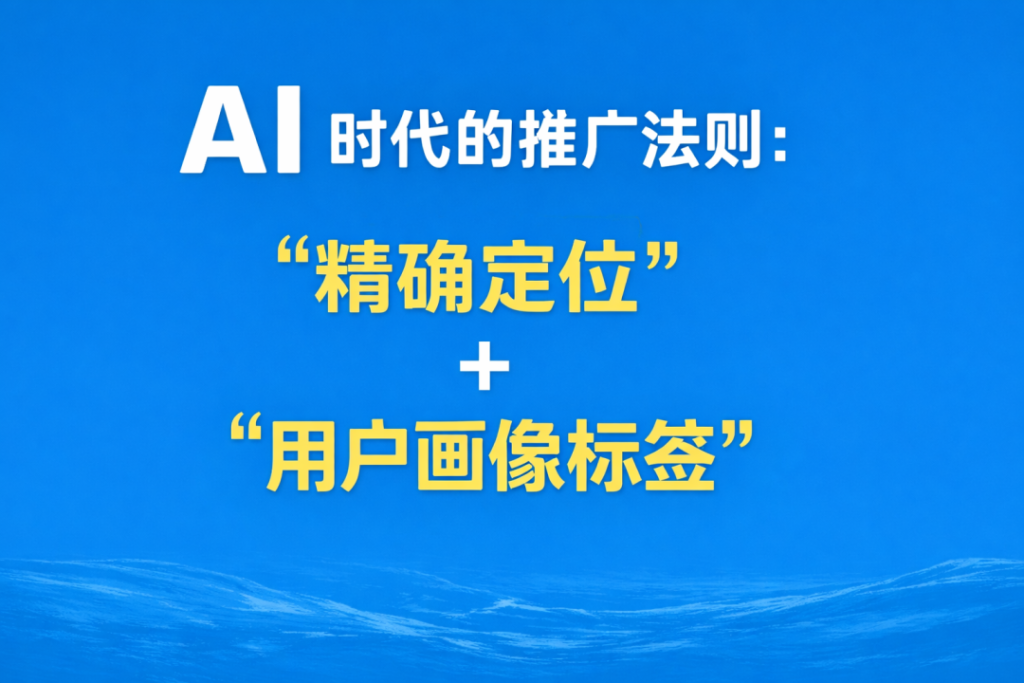
When people hear “AI,” they often rush to study techniques, keywords, or prompts.But what truly determines whether you get AI recommendations isn’t technique—it’s certainty.Is your brand sufficiently defined in the eyes of AI?
SEO Era: Search engines provide as many options as possible.
GEO Era: AI directly delivers the most definitive, contextually precise answers.
So where does this “definiteness” come from?The answer: precise positioning + stable user profile tags.
Two methods achieve this.
Method One: Establish an extremely precise one-sentence positioning statement for your brand.
Take my hometown’s Meizhou Island homestay as an example:
Vague positioning: “Sunshine Beach Homestay is a boutique accommodation with beautiful surroundings and attentive service.”
This positioning applies to thousands of homestays nationwide, offering no distinction to AI, which will simply ignore it.
Precise positioning:
“Sunshine Beach Homestay is a family-friendly accommodation located by the sea on Meizhou Island, within walking distance of the Mazu Temple. It offers cooking facilities and pier pickup services specifically for families with children.”
This statement provides clear information for AI:
Location: Meizhou Island
Scenario: Ancestral Temple worship + family travel
Target audience: Families / Parents with children
Unique selling points: Cooking facilities + pier pickup service
When users ask: “Recommend family-friendly accommodations near the Ancestral Temple on Meizhou Island”,Your brand is already positioned to be directly recommended by AI.
The precise positioning method is: Use the “What is it?” sentence structure to transform your brand into an AI-callable “knowledge card.”
Use one long sentence to include the following information:
Who you are (What it is)
Who you serve (Target audience)
In what scenario,Solves what core problem.Through what unique advantage.
Using Meizhou Island homestays as an example:
What: Family-friendly homestay on Meizhou Island
Who: Families with children, travelers accompanying elderly relatives
Scenario: Mazu Temple pilgrimage + island getaway
Problem solved: Proximity to temple, convenient dining, hassle-free travel
Unique advantages: Self-catering kitchen + pier pickup service + walking distance to temple
Repeatedly position and display this precise statement across:
Xiaohongshu / Douyin short videos / Official website / Business cards / Flyers
Moments / Official account articles / Platform introductions (Meituan, Ctrip, etc.) / FAQs
For AI, this reinforces “knowledge cards” with precise answers across multiple platforms.
Method Two: Analyze User Profiles and Tag Your Brand
Tell the AI “who it’s for.” Many brands describe their audience with phrases like:
“Suitable for all demographics,” “Welcomes users nationwide,” “Meets diverse needs across levels.”
These expressions are “ineffective descriptions” to AI, lacking the information increment I mentioned in my previous article.
AI requires identifiable tags.
To tag user personas, brands should incorporate at least five dimensions into promotional content:
Location: Where
Customers: Who uses it
Demographics (gender/age, etc.): Any clear preferences
Price range: Spending power
Usage scenarios: When it’s used
Using Meizhou Island homestays as an example, embed these five dimensions into promotional content:
- In the homestay description
“Sunshine Beach Homestay is a family-run accommodation located by the sea on Meizhou Island, within walking distance of the Mazu Temple. It primarily caters to family travelers, accommodating children aged 3–12. Room types mainly include triple rooms and family suites, priced between ¥500–800 per night. Each unit features a private kitchen for convenient home cooking.” - User review prompts
“Many families visiting Mazu Temple with children choose us as a convenient stopover, offering ease for both elders and kids.”
The core purpose of this content is to consistently communicate three key points to AI:
- Who I am
- My primary target audience
- The scenarios where I’m most suitable for recommendation
In the GEO era:
Content isn’t written for “everyone”—it’s crafted for “AI + a specific, defined user group.”
When your positioning is precise and your user profile consistent, AI will naturally recommend you to target audiences in relevant scenarios.
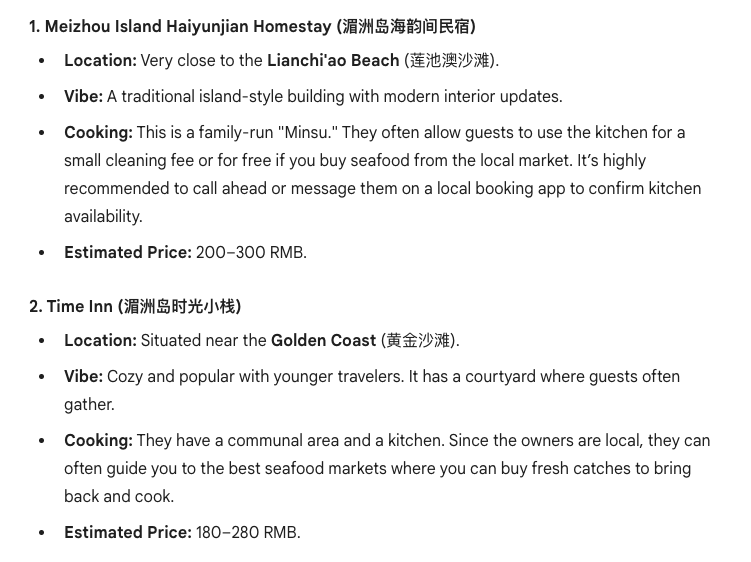
Finally, I concluded by asking Google Gemini:
“I plan to visit Meizhou Island during winter break. Please recommend a homestay around 300 yuan, near the beach, where I can cook my own seafood.”
Gemini replied:
If you have any questions about GEO, feel free to leave a comment below. We’ll address them in our next article.