
As large models enter the “deployment phase,” the true differentiators are no longer just the number of parameters in the model, but how to deploy them effectively, reliably, affordably, and accurately.
Distillation, quantization, fine-tuning, and RAG (Retrieval-Augmented Generation) are precisely the four key engineering techniques for deploying large models today.
Below, we’ll explain it all clearly using accessible examples and real-world model comparisons.
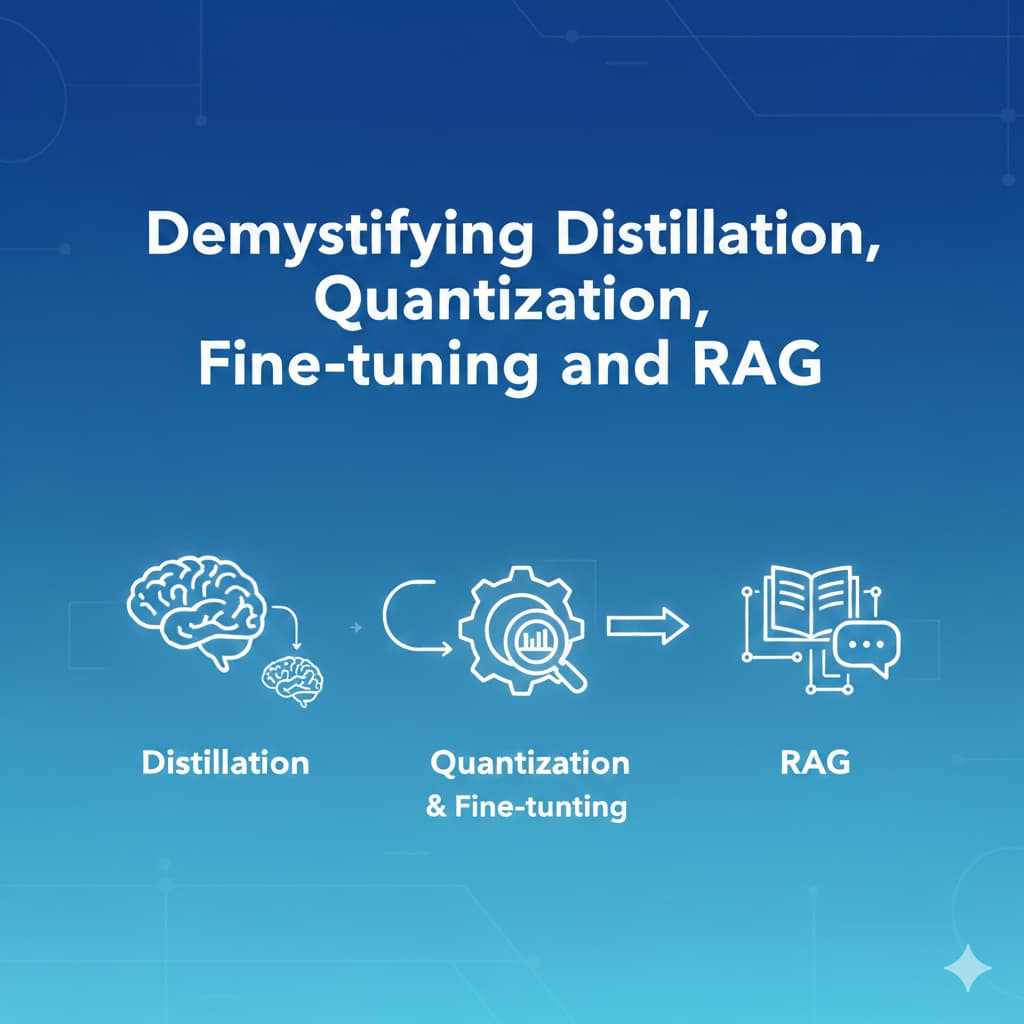
I. Distillation
Using a “teacher model” to train a “student model”.
In a nutshell:
Using a powerful, large-scale model to train a smaller, faster, and more cost-effective model.
For example,
you invited a Tsinghua professor (GPT-4) to give a lecture to your company employees.
But it’s impractical to have a professor handle every routine task. So you assigned a key employee to attend the entire lecture, take notes, and summarize the methods. Afterward, this employee would answer most questions.
This “key employee” is essentially a distilled micro-model.
Core Value:
Significantly reduced costs;
Faster response times;
Better suited for private and on-premises deployment.
Models currently holding a competitive edge in this domain:
OpenAI: Extensive internal adoption of distillation techniques (e.g., GPT-4 → GPT-4o / GPT-4.1 series).
Meta (LLaMA series): Highly mature community distillation ecosystem.
Alibaba Qwen / Baichuan / Zhipu: Demonstrate significant distillation effectiveness in Chinese language scenarios.
II. Quantization
Slim Down the Model Without Sacrificing Intelligence
In a nutshell:
Compress the model from a “premium edition” to a “lightweight version,” consuming less memory and running faster.
For example,
a high-resolution original image of 50MB compressed into a 2MB JPG shows almost no visible difference to the naked eye, yet loads ten times faster.
Quantization performs a similar “compression process” on model parameters.
Core Value:
Significantly reduces graphics memory requirements;
Runs on standard graphics cards or even CPUs;
A key technology for on-premises deployment.
Current models with notable advantages in this area:
Meta LLaMA series: Excellent 4-bit/8-bit quantization performance;
Mistral: Lightweight and high-performance, highly suitable for quantization;
Alibaba Qwen: Maintains strong understanding capabilities after quantization in Chinese contexts.
III. Fine-tuning
Making the Model More Familiar with “Your Industry”
In a nutshell:
Use your industry data and business cases to give the model “specialized training,” making it better aligned with your business needs.
For example,
a general-purpose large model is like a knowledgeable yet broad-based consultant.
Feed it your company’s product specifications, historical customer service conversations, industry terminology, and case studies,
and it will gradually evolve into a “dedicated expert who understands your business.”
Core Value:
More consistent output style;
Higher level of professionalism;
Particularly suited for vertical scenarios such as customer service and sales.
Current models with notable advantages in this area:
OpenAI (GPT-4.1 / GPT-4o): Officially supports high-quality fine-tuning;
Claude (Anthropic): Strong text style consistency;
Qwen / Zhipu GLM: Friendly for Chinese fine-tuning, commonly used by enterprises.
IV. RAG (Retrieval-Augmented Generation)
Enabling models to “research first, then answer questions”
In a nutshell:
Instead of relying solely on internal memory, models first retrieve relevant information from external knowledge bases before generating responses.
For example,
you ask an employee: “What are the specific terms of a certain contract for 2024?”
They won’t answer from memory alone, but rather: open the company document system, locate the corresponding contract, and respond based on the original content.
This is how RAG works.
Core Value:
Reduce “made-up answers”;
Traceable responses, updatable knowledge;
Essential for enterprise knowledge base scenarios.
Current leading models in this domain:
OpenAI GPT-4o: Strong long-context support, robust tool invocation capabilities.
Claude 3.x: Ultra-long context, ideal for document-based RAG.
Qwen / Zhipu: Exceptional Chinese document comprehension.
V. Trend Analysis
The future competitive focus is no longer about “who has the largest model,” but rather who excels at engineering models for practical implementation.
Fine-tuning + RAG will become standard features in enterprise applications.
Distillation + Quantization determine scalability and deployment feasibility.
Large models are shifting from “pursuing intelligence” to prioritizing usability, trustworthiness, and controllability.