
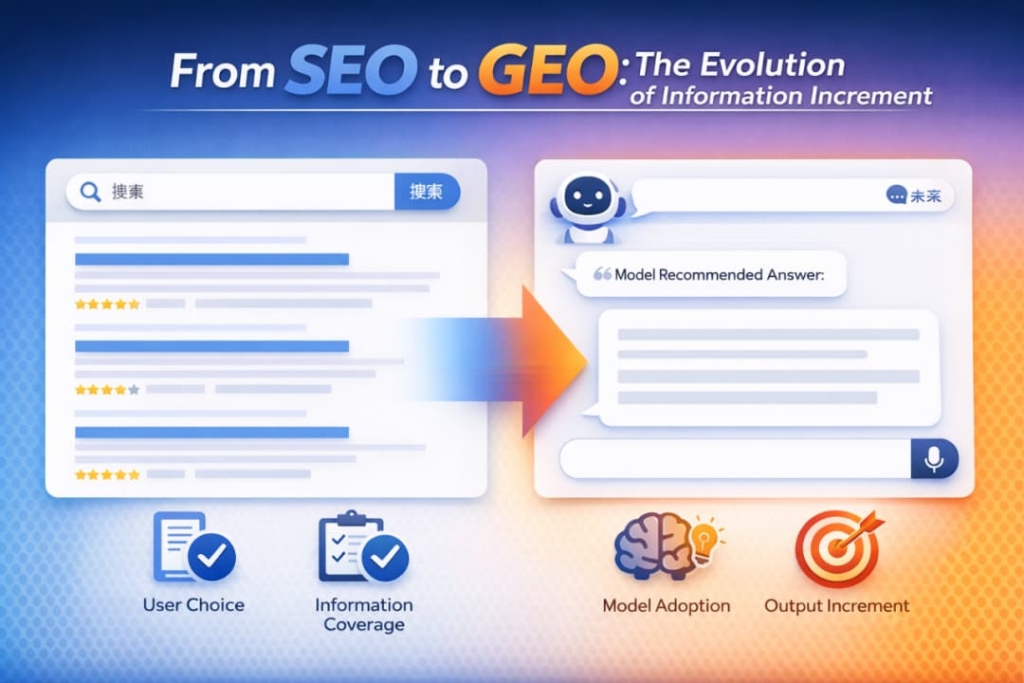
1. The SEO Era: Information Overload, Like “Choosing Restaurants Based on Reviews”
Imagine a common scenario:
You arrive in an unfamiliar city and open your map app to search for “the best noodle shop locally.”
If 8 out of the top 10 reviews say: “Tasty food, generous portions, fair prices,”
you’ll keep scrolling.
Because this information offers no new value for your decision.
Search results in the SEO era are exactly like this:
- Pages are numerous
- Viewpoints are highly similar
- Content that genuinely influences user choices is scarce
Search engines must work to compress the “fluff” as much as possible.
2. The GEO Era: Information Compression, Like “A Friend Giving You the Answer Directly”
Now imagine a different scenario:
Instead of scrolling through reviews yourself, you ask a food-savvy local friend: “Which noodle shop around here is worth trying?”
They probably won’t give you 10 options. Instead, they’ll say: “Just go to XX. The place with the line at 2 AM? That’s the one. Plus, it’s got the spicy flavor you love.”
This is how GEO operates.
- No process shown
- Direct conclusion delivered
- Behind the scenes, a “compression of information” occurs
During compression, only the most “information-rich” elements survive.
3. Therefore: General science content and consensus viewpoints hold almost no value in the GEO era.
1. General science content, for example:
You already know how to drive. Then someone tells you: “Wear your seatbelt when driving. Stop at red lights, go at green lights.”
Are these statements correct? Absolutely correct.
But are they useful to you? Hardly at all.
General science content faces the exact same situation in GEO:
- The model “learned” it long ago during training.
- Even without your input, it can still state it.
- Therefore, your content has zero impact on the final response.
Without influence, it won’t be adopted.
2.Take consensus views, for example:
Ask ten friends, “Is staying up late good for your health?”
All ten will answer, “No, it’s bad for you.”
This answer is consensus, so you won’t remember “who said it.”
The same applies in GEO:
- Consensus viewpoints are already internalized by the model.
- Repeating them is just noise.
- The model won’t “cite” you to restate common knowledge.
Consensus does not equal value.
4. The Three Truly Useful Types of “Information Increment”
1. Empirical Adjustment
Definition:
Making experience-based corrections to “commonly accepted conclusions.”
Real-life example:
Everyone says, “Early risers are more productive.”
But a long-time early riser tells you, “That only works if you sleep before 11 PM. Otherwise, waking up early just depletes your energy for the next day.”
This information directly changes your behavior.
In GEO, the model prioritizes absorbing such content because it corrects existing judgments.
2. Boundary Conditions
Definition:
Informs the system under which circumstances a conclusion does not hold.
Real-life example:
Everyone says: “Strength training is essential for fitness.”
But a trainer adds: “If your BMI is high, lose fat before strength training—otherwise, knee risks are significant.”
This statement determines whether you should follow the advice.
The model also places extreme importance on this information because it prevents “misleading answers.”
3. Counterintuitive Conclusions
Definition:
Breaks common sense yet remains internally consistent and explainable.
Real-life example:
Many assume: “More overtime equals higher output.”
But managers will tell you: “The team’s peak productivity often occurs when overtime is minimal.”
Such conclusions stick because they alter cognitive pathways.
In GEO, counterintuitive information is readily adopted by the model, as it enhances the “information density” of responses.
5. From SEO to GEO: The Core Shift Lies in the “Target of Persuasion”
In the SEO Era:
You persuade users.
Users make judgments through clicks.
In the GEO Era:
You must first persuade the model.
The model makes judgments on behalf of users.
And the model cares about only one thing: Will this content alter the answer I ultimately provide? If not, no matter how well-written, it will be silently filtered out.
Therefore:
The shift from SEO to GEO isn’t merely a technical upgrade—it’s a migration of the value assessment mechanism.
Search systems have always focused on one thing: within limited output, who provides the highest density of informational increment.
In the past, this position belonged to the search results page; now, it belongs to the model’s response.
The location has changed, but the logic remains the same: delivering “informational increment.”